

Equity benchmark Sensex surged past the 57,000-mark by rallying over 1,000 points on Thursday, tracking an overall bullish trend in global equities despite the US Federal Reserve hiking rates. The 30-share BSE index closed 1,047.28 points or 1.84 per cent higher at 57,863.93. Likewise, the NSE Nifty surged 311.70 points or 1.84 per cent to end at 17,287.05.


The RBI has been critical of banks for using restructuring schemes to hide the stress.
'When we look at the quality of our retail loan book, the non-performing asset percentage is low.'

Generally, the central bank grants its approval by mid-March, or latest by March 31, but most banks have not received RBI approval on bonus packages this year.

Whether this remains under control in the coming months will depend on the future intensity and spread of the Russia-Ukraine war, and the effectiveness of the Indian government's response, points out A K Bhattacharya.
The rate, which has been reduced from 14.25 per cent, will benefit all existing home loan and auto loan customers, the bank said. Besides, the bank reduced it benchmark lending rate by half a percentage points to 16.75 per cent.

Loans make money for the lender in the initial years but losses come later when they turn bad.

Avoid discontinuing your SIPs. Persist for at least 7-10 years.

In a double delight, retail inflation eased to a one-year low of 5.72 per cent - staying below the upper tolerance limit for two months in a row, while factory output rose sharply to 7.2 per cent on the back of healthy growth in manufacturing. The retail inflation numbers based on Consumer Price Index (CPI) will provide some room for the Reserve Bank to further moderate the quantum of hike in key interest rate or even press a pause button. The RBI has been on a rate hiking spree since May 2022 in its bid to tame inflation, having raised the repo rate by a cumulative 225 basis points (bps).

Monthly systematic investment plan (SIP) flows into India have held steady above Rs 13,000 crore in 2022-23 (FY23) in the face of markets delivering muted returns in 18 months. However, it is not a rose-tinted view when it comes to viewing new SIP registrations and the cessation of existing ones. The ratio of SIPs stopped as a percentage of fresh SIPs registered (called SIP stoppage or closure ratio in industry parlance) stood at 56 per cent in the first 11 months of FY23, compared with 41 per cent during the same period of 2021-22 (FY22).
Most bankers on Monday ruled out the possibility of lending rates softening following RBI's move to suck out excess liquidity, but housing finance leader HDFC sees a scope for reduction."There is enough liquidity in the system, softening of lending rate could happen," HDFC chairman Deepak Parekh said. Interest rates can come down despite CRR (percentage of total deposits that banks keep with RBI) hike, he said.

Equity fund managers' other favourites are software stocks followed by pharma, finance and consumer non-durables

Most adult Indians should have access to bank deposits, credit and remittance facilities as well as insurance and mutual fund products in the next decade, and technology will play a big role in this transformation, says Tamal Bandyopadhyay.

Probably 35 bps. There could be even an encore in February 2023 to take the policy rate to 6.5% before the financial year ends, predicts Tamal Bandyopadhyay.
The non-watchlist stress emanated from over five year-old loans in the iron and steel, infrastructure and construction sectors.

It is unlikely that the RBI will drop rates until the inflation rate drops below five per cent.

Of the 2,562 customer complaints received between January 2020 and March 2021, a majority relate to illegal apps. At least two dozen suicide cases have been reported, perpetrated by the harassment by loan app operators, points out Tamal Bandyopadhyay.

Shaktikanta Das is a master of the finest balancing act who listens to all but takes his own decisions, discovers Tamal Bandyopadhyay.
As a result, the global investment in developed countries will triple in the next two decades.

The further expansion and upgrade of the Chinese military does not augur well for India, which continues to confront an increasingly belligerent China on its borders, notes former foreign secretary Shyam Saran.
More than 127 million new bank accounts have been opened.

Investors need to evaluate how they stack up against other high credit quality fixed-income options before putting money in them.

The government will not bring down its ownership in public banks.

The Centre's capital expenditure (capex) outlay for the April-June quarter (first quarter, or Q1) of 2022-23 (FY23) could be close to Rs 1.5 trillion, Business Standard has learnt. As a percentage of full-year capex Budget Estimates (BE) of Rs 7.5 trillion, this could be at similar levels to the trends in the past few fiscal years. It is in the July-September quarter (Q2) of FY23 that capex is expected to pick up, when a bulk of the long-term capex loans to states are expected to be expended.

Unhedged exposure of the corporate poses a risk and overall percentage of hedging remains low.

All the 27 public sector banks together have market share of about 70 per cent.
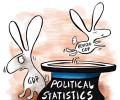
The Economic Survey 2022-23 (FY23), to be presented a day before Union Budget 2023-24 (FY24), is likely to project India's real gross domestic product (GDP) growth between 6 per cent and 7 per cent for FY24, Business Standard has learnt. The broader theme of the Survey could be on how India has dealt with two years of a global pandemic and the ongoing geopolitical disturbance, the strengths and weaknesses that emerged, and what lessons may be learnt. The much-awaited Survey will be the first one by Chief Economic Advisor V Anantha Nageswaran and his team in the finance ministry's economic division.
The country's largest private sector lender, ICICI Bank, on Thursday slashed its benchmark lending rate by 50 basis points to 15.75 per cent, a move that would benefit the bank's home, auto, consumer and corporate loan borrowers.

The Reserve Bank of India's (RBI's) recent decision to allow credit cards for payments through the Unified Payments Interface (UPI) is likely to attract a merchant discount rate (MDR), said a top payment industry source. For smaller merchants, a subsidy for MDR could be provided. "With credit card-UPI linkage, UPI will not only be a payment instrument but also a lending platform. "How can banks lend without a commercial model? Also, the government has said MDR will be zero for payment products but not for lending products," the source said, indicating the MDR regime for credit card-linked UPI payments.

The excise duty cuts on diesel and petrol will cost Rs 45,000 crore and lead to a 0.3 percentage point widening on the Centre's fiscal deficit, a foreign brokerage said on Thursday. Going by the overall consumption, the costs of the surprise move - which came after months of concerns over high payouts at filling stations - for the entire fiscal will come at Rs 1 lakh crore or 0.45 per cent of GDP, economists at Japanese brokerage Nomura said in a report. For the remaining months of the ongoing FY22, the cost will come at Rs 45,000 crore, which leads to an upward review of the fiscal deficit target.
Private banks are assumed to be more efficient at intermediating between depositors and investors.

India has been relatively insulated from the severe headwinds in the West. However, with a third of the global economy expected to slip into recession in calendar year 2023, the impact will strongly be felt on India's exports and trade economy, leading economists said in a panel discussion at the Business Standard BFSI Insight Summit in Mumbai on Wednesday. The panel comprised former Reserve Bank of India executive director and former Monetary Policy Committee member Mridul Saggar, State Bank of India Chief Economic Advisor Soumya Kanti Ghosh, Citibank India Chief Economist Samiran Chakraborty, ICRA Chief Economist Aditi Nayar, and IndusInd Bank Chief Economist Gaurav Kapoor. The topic of the panel discussion was No recession in sight: Is India decoupled from developed economies?

Avoid discontinuing your SIPs. Persist for at least 7-10 years.

The unexpected interest rate hike by the RBI on Wednesday will have the banking system on average making a 10-15 bps gains on the yields, with private banks making larger gains as 57 per cent of their loans are linked to external benchmark rate and 40 per cent to the marginal cost of lending rates, as per a report. Stating that lenders and borrowers will face volatile times with the Reserve Bank raising the repo rate by 40 bps to 4.40 per cent and the cash reserve ratio (CRR) by 50 bps on May 4 in an off-cycle policy move, India Ratings said the market rates had already been moving higher before the move. The 364-day T-bills have moved up 120 bps and 10-year G-sec by 140 bps since May 2020, when the repo rate was cut to a record 4 per cent, which led to an expectation of a faster and sharper rise in interest rates in the system but the central bank stayed the course to support the fragile economy battered by the pandemic.

The attorney general told the apex court that the invasion of privacy was very minimal in Aadhaar and it may not even be considered as an invasion.
Fifty per cent of bank restructured assets were in infrastructure, steel, power and telecom sectors.

For India's leading MFI-turned bank, the challenge is to stay competitive while pricing its loans

With March 2016 being the final quarter when banks will have to disclose their stressed assets, the markets are assuming the worst is yet to come
 © 2026 Rediff.com - Advertise with us - Disclaimer - Privacy Policy - Sitemap - Feedback - About us - Terms of use - Grievances